Free tool

Clay shrinkage calculator

Work out how big a piece comes out of the kiln, or how big to make it so it comes out the size you need. Use your clay’s listed shrinkage, a typical range, or a number you measured yourself.

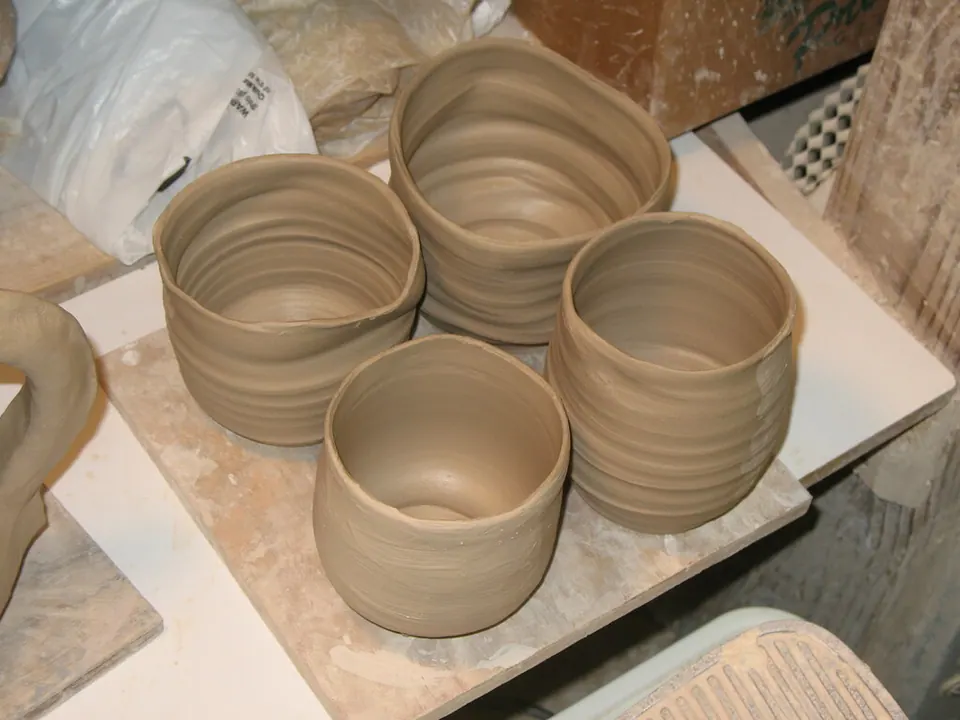
Freshly thrown cups on a board
Photo: bptakoma, CC BY 2.0, via Flickr
I know the…
Typical ranges only. Your clay’s data sheet, or your own test bar, beats any preset.
Fired size—
Size change—
Scale factor (wet ÷ fired)—

fired = wet × (1 − shrinkage)

Measure your own clay’s shrinkage

Roll a slab, mark a line of known length on it while wet (10 cm is easy), fire it to your usual cone, then measure the line again.

Your total shrinkage: —

The math, and the common mistake

Total shrinkage is measured against the wet size: a 12% clay turns 10 inches wet into 8.8 inches fired. Going the other way, divide rather than multiply:

Formulasfired = wet × (1 − shrinkage)
wet = fired ÷ (1 − shrinkage)

Adding 12% to a target size undershoots. For a 4-inch fired piece in a 12% clay, 4 × 1.12 = 4.48 inches wet comes out at about 3.94 inches. The right wet size is 4 ÷ 0.88 = 4.55 inches, a scale factor of 1.136.

Drying plus firing

Clay shrinks first as water leaves it while drying, then again in the kiln as the body densifies. The figure on a clay’s data sheet is usually total shrinkage at a stated cone. Fire the same clay to a lower cone and it shrinks less and stays more porous.

Shrinkage happens in three dimensions

Linear shrinkage applies to height, width and depth, so volume shrinks much more. At 12% linear shrinkage, volume falls to 0.88 × 0.88 × 0.88 ≈ 0.68 of the wet volume, about 32% less. Keep that in mind for mugs sized by capacity and for lids that have to fit.

Measure your own clay

  1. Make a test bar

    Roll a slab about the thickness you usually work at and cut a bar roughly 12 cm long.

  2. Mark a line

    While it is still wet, scratch a line exactly 10 cm long. Mark the clay name and date.

  3. Dry and fire

    Let it dry slowly, then fire it with your normal bisque and glaze firings to your usual cone.

  4. Measure again

    Measure the fired line and type both lengths into the test-bar box above. The calculator gives your total shrinkage.

Questions

How much does clay shrink when fired?
Total wet-to-fired shrinkage is commonly around 5–8% for low-fire earthenware and about 10–14% for stoneware, with porcelain often higher. Your clay’s data sheet, or a fired test bar, gives the real figure.
Does clay shrink more in the bisque or the glaze firing?
Bisque firing adds a little shrinkage. Most firing shrinkage happens as the body approaches maturity in the hotter glaze firing.
How do I size a mug for a set capacity?
Remember that volume shrinks roughly by (1 − shrinkage) cubed. For a 12% clay, make the wet interior about 1.47 times the volume you want (1 ÷ 0.68).
Does air-dry clay shrink?
Yes, as it dries, and it is never fired. Check the maker’s instructions, and expect some shrinkage when you fit it around an armature or frame.

Sources

  1. Ceramic Arts Network, How to determine clay shrinkage and make a shrink rule