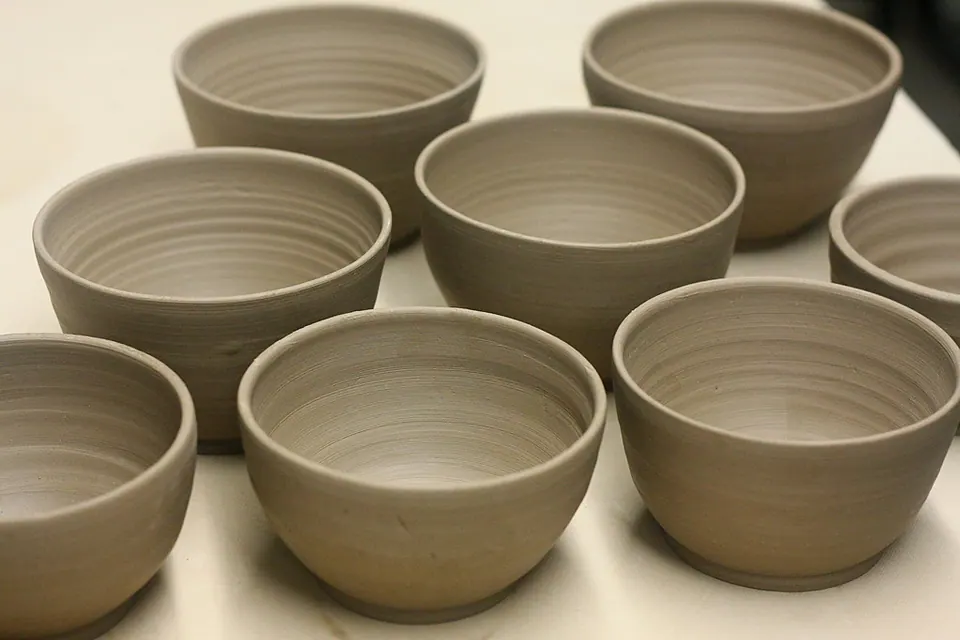
- Clay goes through stages: plastic, leather-hard, bone dry, bisque, glazed. Only unfired clay can be reclaimed.
- Cones describe how hot a firing goes. Low fire is about cone 06 to 04, mid fire cone 5 to 6, high fire about cone 10.
- Earthenware, stoneware and porcelain are the three main clay families, fired at increasing temperatures.
- Food-safe means the glaze maker says so when fired as directed; it is not true of every glaze.
- Terms link to deeper guides and tools where they help.
This pottery glossary explains 80 common terms you will meet in classes, glaze labels, kiln manuals and pottery videos. Definitions are short and practical, with links to deeper guides where a term needs more than a sentence.
Start with the overview of clay stages and cone ranges below, then jump to the letter you need. Firing temperatures come from Orton's cone chart; safety terms point to OSHA, NIOSH and FDA sources in the linked guides.
What do the most important pottery terms mean?
Most pottery vocabulary describes two things: how dry the clay is and how hot it has been fired. Learn the stages of clay and the main cone ranges first, and the rest of the glossary falls into place.
Clay stages, from wet to finished
| Stage | What it means | What you can do | Can it be reclaimed? |
|---|---|---|---|
| Plastic (wet) | Soft, workable clay | Throw, pinch, coil, roll slabs | ✓ Yes |
| Leather-hard | Firm but damp | Trim, attach handles, carve | ✓ Yes |
| Bone dry | All free water gone | Load for bisque; handle gently | ✓ Yes |
| Bisque | Fired once, porous | Glaze | ✗ No |
| Glazed ware | Glaze fired | Use, if the glaze suits the purpose | ✗ No |
Where common cone ranges fall
Orton self-supporting cones at the medium heating rate (108 °F/hr), °F
Cone numbers with a leading zero, such as 06, are lower than cone 1, and they get cooler as the number after the zero gets bigger: cone 06 is hotter than cone 019 but cooler than cone 04. Cones without a zero get hotter as the number rises, so cone 10 is hotter than cone 6.
Orton cone temperature chartLook up any Orton cone at three heating rates, in °F and °C.Pottery terms A–B
- Ash glaze: A glaze that uses wood or plant ash as a main flux. Ash glazes tend to run and give streaky, earthy surfaces, especially at high fire.
- Banding wheel: A heavy turntable spun by hand, used for coiling, decorating and checking symmetry. Not motorized. See the best banding wheels.
- Bat: A flat, removable disc that attaches to the wheel head with pins. You throw on the bat and lift it off, so the pot is not distorted when you move it. See the best wheel bats.
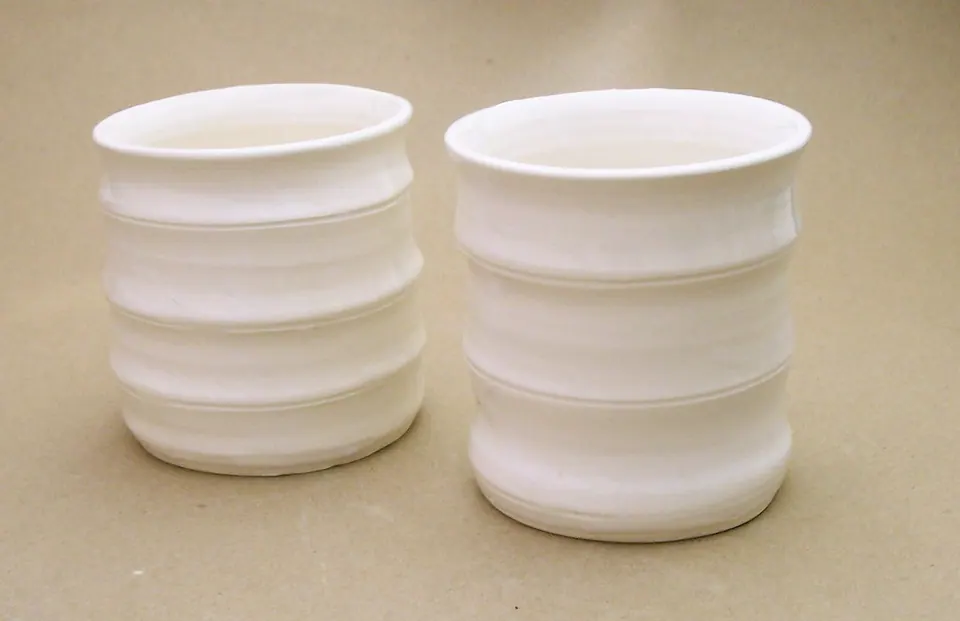
- Bisque (bisqueware): Clay that has been fired once, without glaze. It is hard and porous, so it absorbs glaze evenly, and it can no longer be reclaimed with water.
- Bisque firing: The first firing, which turns dry greenware into bisque. It is often fired around cone 06 to 04. See bisque vs glaze firing.
- Bone dry: Clay that has lost all the water it can lose at room temperature. It is pale, fragile and ready for the bisque firing. Handle it gently: it breaks easily and makes dust.
- Burnishing: Polishing leather-hard or bone-dry clay with a smooth stone or spoon to compress the surface into a soft sheen without glaze.
Pottery terms starting with C
- Calipers: A measuring tool with two arms, used to match the width of rims and lids so pieces in a set, or a lid and its pot, fit together.
- Celadon: A family of translucent glazes, traditionally pale green to blue, that pool in carved and textured areas.
- Centering: Pressing spinning clay into a symmetrical mound on the wheel head so it runs true. It is the first and hardest skill on the wheel; see how to use a pottery wheel.
- Ceramic: Clay that has been fired to the point where it can no longer soften in water. Bisque and glazed pottery are ceramic; greenware is not.
- Chuck: A form that holds a pot upside down on the wheel for trimming, such as a clay chuck or a mechanical trimming chuck like the Giffin Grip.
- Clay body: A specific clay recipe, with its own firing range, color, texture and shrinkage. A cone 6 B-Mix and a cone 04 white earthenware are two different clay bodies.
- Coil building: A hand-building method of stacking ropes of clay and blending the joins to build walls. See pottery without a wheel.
- Cone (pyrometric cone): A small, slender pyramid of ceramic material that bends at a known combination of temperature and time. Potters use cone numbers, such as cone 06 or cone 6, to describe how hot a firing goes. See the cone chart.
- Cone pack (witness cones): A set of cones, usually three in a row, placed where you can see them through a peephole or on a shelf. Their bending shows whether the kiln reached the target cone.
- Crawling: A glaze defect where glaze pulls back into beads or islands and leaves bare clay. It is often caused by dust, oil or glaze applied too thick. See glaze defects.
- Crazing: A network of fine cracks in a glaze, caused by the glaze shrinking more than the clay as it cools. On food surfaces it can trap food and bacteria.
- Cut-off wire: A length of wire with handles, used to cut clay from the block and to cut thrown pots off the wheel or bat.
Pottery terms D–F
- Decal: A printed image transferred onto glazed ware and fired at a low temperature, usually in an overglaze firing.
- Downdraft vent: A kiln vent that pulls a small amount of air out through holes in the kiln floor or lid and exhausts fumes outdoors through a duct. See pottery studio safety.
- Duty cycle: The share of a firing during which the kiln's elements are actually on. It is used to estimate firing cost; see the kiln firing cost calculator.
- Earthenware: Low-fire clay, usually fired around cone 06 to 04. It stays somewhat porous unless glazed, and it is often red or white. See stoneware vs earthenware vs porcelain.
- Engobe: A slip formulated to sit between a clay and a glaze, often used to change surface color. The line between engobe and slip is blurry in everyday use.
- Extruder: A tool that pushes clay through a shaped die to make coils, tubes, handles and trims. Ranges from small handheld guns to wall-mounted units. See the best clay extruders.
- Feldspar: A common mineral used in clay bodies and glazes as a flux. It helps clay and glaze melt and vitrify.
- Fettling knife: A long, narrow knife used for cutting and trimming clay, especially slabs and seams on cast pieces.
- Flux: Any material in a clay or glaze that lowers its melting point. Fluxes help the glaze melt into glass at a practical temperature.
- Food-safe: Describes a glaze that its maker states is suitable for food contact when applied and fired as directed. Actual safety depends on the clay, application and firing; sellers should consider lab leach testing.
- Foot ring: The raised ring of clay on the bottom of a pot, usually trimmed at leather-hard. It is typically left unglazed so the pot does not fuse to the kiln shelf.
- Frit: A pre-melted, ground glass used in glazes. Fritting makes some materials more stable and less soluble.
Pottery terms G–H
- Glaze: A thin coating of glass-forming materials applied to bisque and melted in the kiln. It adds color, seals the surface and can make pottery food-safe when the glaze is designed and fired for it. See how to glaze pottery.
- Glaze firing: The firing that melts the glaze, often to a higher temperature than the bisque firing. Mid-fire glazes are commonly fired to cone 5 or 6.
- Greenware: Any unfired clay piece, from freshly made to bone dry. Greenware can still be reclaimed.
- Grog: Clay that has been fired and ground into particles, then added to a clay body. Grog adds tooth, reduces shrinkage and helps large pieces dry evenly.
- Hand-building: Making pottery without a wheel, using pinch, coil, slab and mold methods.
- Hump mold: A convex form that you drape a slab over to shape a bowl or plate.
Pottery terms K–L
- Kaolin: A pure, white clay mineral, also called china clay. It is the main clay in porcelain and many white bodies.
- Kiln: A high-temperature oven for firing clay and glaze. Home kilns are usually electric; others fire with gas or wood. See the best kiln for home.
- Kiln furniture: Shelves, posts and stilts used to stack ware inside a kiln. See the best kiln shelves and furniture.
- Kiln wash: A refractory coating brushed onto the top of kiln shelves so drips of glaze can be scraped off instead of fusing the pot to the shelf.
- Leaching: The release of materials, such as lead or cadmium, from a glaze into food or drink. The FDA sets limits for leachable lead and cadmium from ceramic ware used with food.
- Leather-hard: Clay that is firm enough to hold its shape and be handled but still damp and cool. It is the right stage for trimming, joining handles and carving.
- Luster: A metallic overglaze, such as gold, that is fired at a low temperature on top of a finished glaze.
Pottery terms M–O
- Majolica: A decorating method in which colored glazes or stains are painted onto an unfired opaque white glaze, usually on earthenware.
- Maturity (maturing temperature): The firing temperature at which a clay body reaches its intended strength and density. Firing below it leaves the clay weak and porous; firing far above it can cause slumping or bloating.
- Mid-fire: The cone 5 to 6 firing range, about 2,167 to 2,232 °F at Orton's medium rate. It is the most common range for home electric kilns that can reach stoneware temperatures.
- Opening: The step on the wheel after centering, where you press into the center of the clay to form the floor of the pot.
- Overglaze: Decoration applied on top of a fired glaze and fired again at a low temperature, such as lusters, decals and china paint. Orton's lowest cones, 022 to 019, cover this range.
- Oxidation: A firing atmosphere with plenty of oxygen, which is normal in electric kilns. Glazes look different in oxidation than in reduction.
Pottery terms P–R
- Pinch pot: A small pot formed by pressing and pinching a ball of clay between thumb and fingers. It is usually the first project in hand-building.
- Pinholing: A glaze defect of tiny holes in the fired surface, often caused by gases escaping from the clay or glaze during firing.
- Plasticity: How well clay can be shaped without cracking and hold the shape afterward. Highly plastic clay throws easily; short clay cracks when bent.
- Porcelain: A white, dense clay body based on kaolin. It can be translucent when thin, and it is known for being demanding to throw because it is soft and less forgiving.
- Pug mill: A machine that mixes and compresses clay into a solid log. De-airing pug mills also remove air, which saves wedging time.
- Pulling: Lifting the clay wall upward between your fingers on the wheel to make it taller and thinner. Also the hand method for making handles from a lump of clay.
- Raku: A low-temperature firing in which pots are removed from the kiln while red-hot and placed in combustible material. It gives crackle and smoke effects; raku ware is not food-safe.
- Reclaim: Unfired scrap clay that is slaked in water, dried and wedged back to a workable state. See how to reclaim clay.
- Reduction: A firing atmosphere with limited oxygen, usually in a gas kiln. It changes how metal oxides in glazes and clays color, giving effects such as copper reds.
- Rib: A flat tool of wood, metal, rubber or polymer used to shape, smooth and compress clay. See the best pottery ribs.
Pottery terms starting with S
- Scoring: Scratching crosshatched lines into two clay surfaces before joining them with slip. Score and slip is the standard way to attach handles, coils and slabs.
- Sgraffito: Scratching through a layer of slip or underglaze to reveal the clay underneath, usually at leather-hard.
- Shivering: A glaze defect where the glaze flakes off the edges, the reverse of crazing. It happens when the glaze shrinks much less than the clay.
- Shrinkage: The loss in size as clay dries and fires. Mid-fire stoneware typically shrinks around 10 to 13% overall. See the clay shrinkage calculator.
- Silica: Silicon dioxide, the main glass-former in glazes and a major part of clay. Its crystalline form becomes a hazard as respirable dust, which OSHA regulates in workplaces.
- Slab: A flat sheet of rolled clay used to build boxes, plates, mugs and trays. See the best slab rollers.
- Slaking: Letting dry clay break down in water. It is the first step of reclaiming.
- Slip: Clay mixed with water to a creamy liquid. Used as glue for joins, as a decorative coating and, in a special recipe, for slip casting.
- Slip casting: Pouring liquid casting slip into a plaster mold. The plaster draws water out, forming a clay wall, and the extra slip is poured out.
- Slump mold: A concave form that you press a slab into to shape a plate or bowl.
- Stilt: A small support with pointed tips that holds a glazed piece off the kiln shelf. Mostly used for low-fire ware; stoneware usually sits on an unglazed foot instead.
- Stoneware: A dense, strong clay fired to mid or high fire, commonly cone 6 or cone 10. It is the most common clay for functional pottery made at home.
Pottery terms T–W
- Terra sigillata: A very fine slip made from the smallest clay particles. Burnished or polished, it gives a soft sheen without glaze.
- Thermocouple: The temperature sensor in a digital kiln. It wears out over time and is a common replacement part.
- Throwing: Forming pottery on a spinning wheel. Throwing includes centering, opening, pulling and shaping.
- Trimming: Removing excess clay from the bottom of a leather-hard pot on the wheel to form a foot ring and even out weight. See the best trimming tools.
- Underglaze: A colored clay-based coating used for painting designs, usually covered with clear glaze. See underglaze vs glaze.
- Vitrification: The point in firing at which a clay body becomes dense and glassy enough to absorb very little water. Stoneware and porcelain are fired close to vitrification.
- Wax resist: A liquid wax painted on areas that should stay free of glaze, such as the foot. The wax burns off in the firing.
- Wedging: Kneading clay to remove air pockets and even out moisture. Ram's head and spiral wedging are the two common methods. See the best wedging boards.
How to use this pottery glossary
Terms here are written for home potters and beginners, not for materials scientists. Where a term has a safety or food-safety angle, follow the linked guide for sources.
- New to the wheel? Start with centering, opening, pulling, trimming and bat, then read how to make a mug.
- Planning firings? Read cone, bisque firing, glaze firing, maturity and vitrification, then cones and the cone chart explained.
- Choosing clay? Compare earthenware, stoneware and porcelain, and see the clay category.
- Glazing? Check glaze, underglaze, food-safe, leaching, crazing and crawling, and the food-safe hub.
- Setting up a studio? See silica, downdraft vent and wedging, and the beginners hub.